


KILMERIS
Predator of the Sulfuric Marsh
Kilmeres (s: Kilmeris) live in the acidic waters of the sulfuric marsh. Growing up to three metres in total length, these solitary aquatic creatures lure prey in with their luminescent antennae, then use their sharp forearms and vertical beak to pierce and stab their prey.


Creature Designs


The Kilmeres have evolved their musculature to suit its environment and behaviours. It lacks much muscles in its limbs, which is why it relies on quick, stabbing movements to hunt as opposed to stronger ones.
It has swimming muscles throughout the length of its body that allow it to use its whole body to propel it through the water.
-
Kilmeres’ main method of hunting is using their sharp beak and pincers to stab unsuspecting prey.
-
They might use their dorsal lights or tail light which they are born with as bait to lure aquatic creatures in the dark waters of the sulfuric marsh.
-
Living fully underwater, they have special eyelids and skin that protect their organs from the corrosive acidic waters. Their pink skin also helps to camouflage in the reddish waters.
-
Kilmeres store their prey on land, and have enlarged lungs as opposed to other aquatic creatures to stay on the surface for a longer period of time.
Skeleton and Musculature

A single Kilmeris may live up to 30-40 years. They are ovoviviparous, releasing 5-8 eggs in their wombs where the hatchlings mature up to the cub stage. Cubs may fight each other within the womb for dominance and sustenance before emerging from the mother as a juvenile Kilmeris, eventually maturing into the fully adult stage.
Life Cycle of a Kilmeris


The Kilmeris’ bone structure is similar to certain fishes, eels, different birds and snakes. They also have human-like shoulders and legs. They can be classified as digitigrades, as they have ‘duck feet’ that they use to stand on and pedal in the water. The spines of the dorsal fin are made up of cartilage, allowing the Kilmeris to create swaying movements with their fin that can attract underwater prey.

GAIT

HUNTING STRATEGY

Kilmeres have mainly three positions: swimming, walking and standing.
When swimming, they tuck their limbs in, weaving in-between the stilt roots of the marsh trees. They use their webbed hind feet to paddle when walking on the marsh bed.

Kilmeres are solitary creatures, so they rely only on themselves to hunt for food. Although they may occasionally eat other aquatic creatures, they prefer to prey on the larger land animals in the marsh such as the Nopickles. When doing so, they use their feet to burst out of the water, stabbing the unsuspecting prey with their sharp pincers and beak.
Having bad eyesight, the Kilmeres use a strong echolocation to discover the whereabouts of their prey.
FEEDING HABITS

When feeding, they prop themselves up on their feet and secondary limbs. This is to use their front limbs to tear apart flesh, as well as to reach a vertical position to facilitate swallowing. Kilmeres tend to store their prey on their land territory to prevent other Kilmeres from accessing their food.

DIMORPHISM
Male and female Kilmeres look relatively similar, with the males being smaller in stature and having dimmer lights than the female.
In this species, the female is the more dominant sex, and the female is the one who will choose and pursue which male Kilmeris to mate with.
MATING AND BIRTH
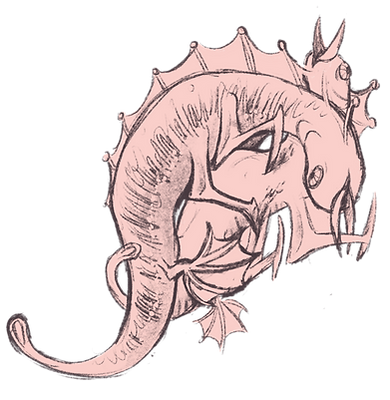

The female Kilmeris leads the mating process by seeking out the strongest male Kilmeris. She engages with him violently, typically killing and eating him.
After birth, there is no parenting involved
from the mother. Young Kilmeres are birthed with pincers and beak formed, ready to begin hunting smaller prey in the water.
SPLASH ART

Nopickles (midground) and Nooli (foreground) designed by Chew Ho Yuan and Han Si Ling respectively.



Maghraguin
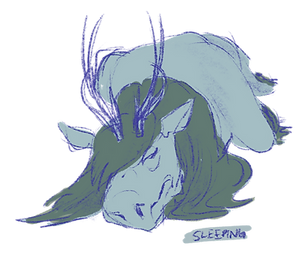
Mountain-dwelling creature
Usually found in small herds, this cervine creature feeds on fish in freshwater lakes near their habitats. Their long leg hairs and mane stimulates the appearance of floating aquatic plants when submerged underwater, camoflaging this predator to grass-dwelling fish.

